28 Years Later
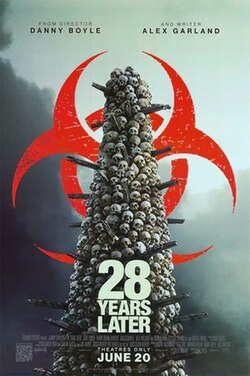
28 Years Later
I wasn’t exactly foaming at the mouth at the prospect of 28 Years Later, a legacy-sequel to the 2003 zombie-outbreak film 28 Days Later (and it’s first sequel 28 Weeks Later). The honest to God truth is that I was pretty indifferent to the film series. I even re-watched 28 Days Later a couple weeks before watching 28 Years Later and discovered that I remain indifferent to that film. I don’t hate it, but I can’t honestly say it left an impression on me at all or asked me any questions that I found were worthwhile to the well established zombie sub-genre. Maybe I am struggling to get into the head space of what other people saw in 2003, in comparison to what I’m seeing now in 2026. Either way, I wasn’t a huge fan of it.
The only reason this new film ended up on my radar at all is because of all the positive reviews, friends coming up to me and telling me to watch it, and because my wife likes herself a good zombie film.
Unfortunately for the series, I don’t think I was a contrarian in that regard. The series was well received by critics and general audiences, but it didn’t stay in peoples’ collective subconscious the way some other series’ have.
Neither of the original films cracked 100 million at the worldwide box-office with budgets of 10 to 15 million apiece. Playing an arm-chair film producer, giving the green light to 28 Days Later 3 in 2010 (or some other, closer time frame) would likely result in a film that’s, at best, as successful as 28 Weeks Later (about 70 million made off 15 million dollar budget). Imagining a legacy sequel, factoring in built-up demand, the changes in the genre post-The Walking Dead and The Last of Us, and, of course, inflation, I could see the logic of believing 28 Years Later would gross 150 million worldwide (like it did).
The decision to afford it a 60 million dollar production budget was pretty bold though.
I only bring it up because I wish the film would have been rewarded more than it was. I would have liked this to have been a comeback for the ages, like Final Destination: Bloodlines swooping it and making 300 million worldwide, but it just wasn’t to be. We haven’t even brought up how this movie’s sequel (The Bone Temple) did.
On the bright side of things, the artistic side, not the financial, 28 Years Later is a triumph in filmmaking and a triumph for the zombie sub-genre.
As a sub-genre, zombies can often feel pretty played out. We have had a million ideas, a million good ideas thrown at it, but, now, a lot of the old ideas have either been done to death or they’re too little, too late to pull me in as a viewer. When The Last of Us came around, it did something in the same vein as The Walking Dead, that is, it makes it more about the characters themselves than it does the zombies. It became less about constantly being on the run from hordes of zombies and, more so, about the practicality of what living in such a world would feel like. They’ve all dealt with morality and pride and egos, and all the ways that humans will become territorial and find ways to hurt each other to protect themselves, and this is something more like that.
Basically, the film tells its story as though the British Isles were thrown away and deemed a lost cause, put under permanent quarantine, with very few survivors to speak of. This includes a small village that is on an island separate from the mainland. They have to cross over to the mainland every now and again for supplies, but they have a fortress to barricade intruders, and the only way to cross from the small island to the main land is a long, narrow bridge that floods with the tide.
It’s a neat setting – how they have to factor in the tides so they aren’t thrown off the bridge, the visual of them leaving and venturing directly into the unknown. Accounts for historical events are distorted. given there is no longer a living record for them to pull from. There are some parallels to COVID-19 and everything that happened with that, but, for the most part, all it adds up to is an interesting, lived in world that feels both realized and plausible.
The film sees Danny Boyle at the helm as the film’s director (as he was with 28 Days Later), and the film stars Aaron Taylor-Johnson, Jodie Comer, Ralph Fiennes, and Alfie Williams.
Early on, I went into the film thinking I just about knew what the film would be by the first fifteen minutes alone. The story sees Jamie (Johnson) take his son Spike (Williams) onto the mainland for the first time for training. I assumed one of two things would happen during training – either the father would become infected, leaving the young boy to come to terms with his father’s death and survive his journey back to the island, or the boy would be lost, allowing this to be about Jamie’s fight to save his son. Then, I realized this is the story of Spike trying to find a mysterious doctor on the mainland in-order to get treatment for his sick mother, and I think that’s the most I’d divulge before anyone watches it (which you should).
Aaron Taylor-Johnson does really well in it, playing a troubled, flawed father, who is feeling the strains of a broken world, and doesn’t always let it bring the best out of him. In 2010, when I first saw Kickass, I had a perceived trajectory I saw for Aaron Taylor-Johnson that looked nothing like this. What started with his playing a nerdy superhero, later became him playing a rather generic action character in Godzilla, my least favorite of the Quicksilvers, and Kraven the Hunter in a box-office disaster for Sony‘s Spider-Man Universe. This film is where I like him best, coming off as one of the most natural performances I’ve ever seen from him.
Meanwhile, the teenage Alfie Williams, in his first major starring role, also does really well, accomplishing the complexities of his character with maturity beyond his years. Comer and Fiennes are also good. Comer plays the sickly mother who can’t trust her own mind, whereas Fiennes plays the mysterious doctor whose motivations are initially unclear.
It all comes together really well to tell an engrossing drama that looks for the beauty in what’s awful.
And that’s really what it came down to with me for this film. I enjoy zombies well enough and I can appreciate grisly, cutthroat brutality in a film, but this is a film that definitely has something to say that’s more than that. It has a melancholic gleam, but also a hopeful undertone, so long as you’re willing to look for the light over the pillar of skulls.
I won’t lie and I’ll admit I teared up a little on this one.
It’s a film with a concept that could have easily succumb to its own pretentiousness, doing less is more until, effectively, nothing gets done, like some art-house horror sometimes does in the name of being a slow burn, but it doesn’t. I found it to be an easy, engaging watch, with a story that feels self-contained and complete, while also leaving a new set of breadcrumbs for us to follow heading into its sequel. For me, personally, it may be one of my new favorite zombie films. I highly recommend it and look forward to sharing my thoughts about The Bone Temple.